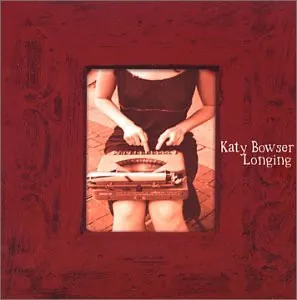
This is one review I'm not looking forward to writing. I'm just not sure I'm up to it. It's not an easy task describing music that is as inexplicable and eclectic as Katy Bowser's. I've been listening to Longing, Bowser's sophomore release for a couple of weeks now. Just as I get ready to pat myself on the back for coming up with what seems like an appropriate label for her music, the next cut comes along and shatters my elaborate characterization. Katy Bowser defies labels.
Bowser's writing is vulnerable and transparent. Her lyrics bleed with emotion. If she reads anything I write that might be construed as negative, she might cry. The wistful and melancholy tone of Bowser's poetic lyrics calls to mind an author with a sweet and sensitive spirit. It takes courage to write with such personal honesty. The haunting "Words Are Still Coming" illustrates the emotive voice that Bowser consistently employs throughout Longing:
You broke the silence after breaking my heart open,
Struck a chord already ringing in me.
This isn't safe to me, still I would rather be feeling the breaking than nothing at all,
and words are still coming.
Instead of providing clarity, sometimes songwriters aiming for a poetic flow end up leaving the reader confused. Not so, with the Bowser lady. I sort of imagine this songwriter laboring over and analyzing every line and word until just the right image comes forth. That's not to say her lyrics go down like sugar because they don't. Skilled writing usually requires sweat. That which is created with pain often must be interpreted with some distress.
Katy Bowser is an original but is reminiscent of female singer/songwriters such as Sarah McLachlan, Ani DiFranco, Tori Amos, and Joan Baez. Growing up as a "military brat" in such diverse locations as Germany, New Orleans, Pennsylvania, Georgia, and DC might partially account for such diverse inclinations. Some reviewers have suggested influences as varied as folk, rock, country, and Celtic. You will certainly hear all that and more. If you listen intently enough, you will even hear an intermittent blues sway. Producer Russ Long (Sixpence None the Richer, Over the Rhine) recruited an impressive roster of supporting instrumentalists, but used their skills judiciously. The production is consistently sparse and clear. Rather than muddy and cluttered, we get a modest instrumental treatment. I was surprised to see the list of instruments used on this album. The list is much longer than I expected. Chris Donahue (Over the Rhine, Vigilantes of Love, Fleming and John), Ken Lewis (David Wilcox, Phil Keaggy), Chris Grafagnino (Wes Cunningham) and Kenny Meeks (Jan Krist, Phil Madeira, Sixpence None the Richer, Buddy Miller) and Matthew Perryman Jones all contribute. Even accomplished player Michael Aukofer, who has toured with Rich Mullins and Mitch McVicker, lent his hammered dulcimer talents to "Michigan".
Longing is best appreciated on an overcast day. Nearly every song, even those with words that might be considered cheerful in another context, assume an aura of wistful gloom. Bowser sings with such yearning and sincerity in this project, that any hint of joy, at best, seems subdued. This is evidenced primarily in the tone of her delivery, but also explicitly in the downhearted ambiance of the lyrics. Take "Chiffon Dress," an apparent optimistic ode to the future:
She's got a chiffon dress that swings around. Two bare feet that barely touch the ground.
The pain of life, it cannot hold her, she knows what her lover told her.
She's got two long arms to touch the sky, the way she moves, you'd think that she could fly.
Those words read hopeful and sunny. Listening to Bowser sing this song though sounds like something closer to a dirge. Here's the curious thing. I downloaded and listened to Bowser's live performance at Huntington College in Indiana. With the benefit of her song introductions and a jaunty, relaxed manner, the material seemed more upbeat. Contrasted with studio recordings, live performances are usually scintillating. That truism is demonstrated indelibly with Katy Bowser.
"Idol Song" is the only selection with any kind of kick. It flat out rocks (I told you the music was eclectic). Ironically, in a song dealing with the serious subject matter of worldly influences, Bowser actually sings with more enthusiasm and delight than with any other song on the album. It sounds like she is cutting the musical chains that bind her.
Katy Bowser's musical style isn't "in your face." For me, it was an acquired taste. I've got to believe she is a complex, thoughtful, poetic, substantial person. It takes time and patience to know and appreciate people and artists of that ilk. Yet, there is a massive payoff. Rather than forgettable, disposable, surface pap, we have a serious, profound work that will offer fresh insight and truth with each listen.
3.5 tocks
Other coverage for this album
The Rebel Base 2001Reviewed by Josh HurstEvery now and then, it's good to take a break from all the gimmicks of popular music. There is a time and a place for hip-hop beats, computerized sound effects, and ready-for-radio hooks, but sometimes a nice, stripped down folk album is a breath of fresh air. Katy Bowser is a bit more progressive than most folk artists, but her music is about as stripped down as it gets. Longing, the 2001…