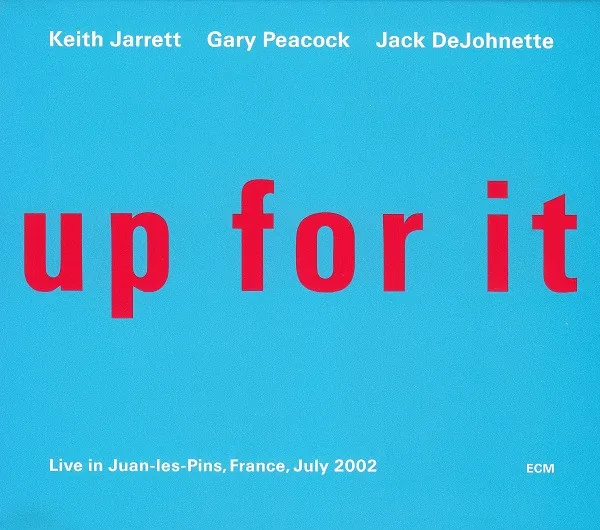
Up For It, Keith Jarrett's fourth trio release since his recovery from a bout of Chronic Fatigue Syndrome several years ago, continues his steady climb into the jazz world's echelon. Jarrett (with his long time musical mates bassist Gary Peacock and drummer/percussionist Jack DeJohnette) returned from his malady with renewed vigor and, perhaps, humility. This reviewer attended a concert in Chicago three years ago in which a sense of humor was displayed in the song selection and even in the breezy manner of the performance as the three amicably exchanged smiles throughout. This display was in extreme contrast to the pianist's austere behavior during his solo concerts from which he gained much notoriety. With this slight mood change, it seems that the trio has, ironically, become the new music of the bourgeois audience who demands that their music not be too demanding, accepting the umpteenth version of "Autumn Leaves" just so long as their sensibilities aren't tested too much.
In essence, there's not much difference between this disc and the others: Jarrett, repertoire planned or not, allows the bass and drums to be occupied before his entrance; he sits down and pauses as though entreating a séance; and then he proceeds with the melody, with Peacock and DeJohnette following along with the deftness and facility of old partners. Jarrett, who is most often compared to the late Bill Evans (who pretty much invented the modern trio approach with bassist Scott LaFaro and drummer Paul Motian), actually borrows from several influences, most notably Art Tatum, Earl Hines, and Wynton Kelly (with a slight touch of Monk here and there): hear the stride feeling of "If I Were a Bell" that evokes the mild swing of the beloved Miles Davis' recording.
What Jarrett's audience expects is his improvisational genius to be displayed at every turn--an extension of his '70s-'80s protean solo production for ECM. While that genius was evident throughout, what separated the iconoclast from other musicians was his dependency on a fawning audience. What the audience got was the right to watch a technician practice his ideas; what he got was their money and the challenge of solo performance (that could be converted to record). From an artistic/rhetorical standpoint, Jarrett was generating a context in which all his performing would be placed: the genius and his adoring tribe. A necessary distance was created, allowing him to practice freely AND publicly while assuring the presence of an appreciative throng.
For Jarrett and his mates, this strategy has worked wonderfully. Already held in high regard based on the groundbreaking "Standards" albums, Jarrett, upon his return to public performance, found an eager audience. Tokyo 96 was an excellent comeback, and the 2-CD Whisper Not, an ambitious effort for anyone else, received critical acclaim--it seemed Jarrett's natural lyricism and rhythmic sense hit the mark on every song.
The group's next CD, seemingly a hurried release, took advantage of the momentum of the previous two to get initial interest. Inside Out was the trio's first all-improvised, all-original effort since the late '80s, when Jarrett was still experimenting with more ethereal and slightly dissonant forms. Inside Out should have been as big a success as the other recent releases, had the bulk of Jarrett's fans been as savvy as he is. It is sprinkled with a blues feeling that brings the music together harmonically, giving the recording an integrity that can be appreciated by most any jazz fan. Alas, it was not to be.
So, on this new CD, for the most part, we get what we've heard before--sort of. With the exception of John Lewis' "Two Degrees East, Three Degrees West" and the title excursion, Jarrett has recorded all the songs at least once before, with "Leaves," "Scrapple From the Apple," and "My Funny Valentine" closest to becoming the standards of the standards for this group. "Bell" swings, a welcome treatment; "Valentine" is less pensive than usual; "Butch & Butch" bops harder than the more logical choice, "Scrapple"; "Two Degrees" is given, honorably, a spare approach that mirrors that of its recently-deceased creator; and this version of "Leaves" reflects the grandfather of modern improvisation, Coleman Hawkins, in its tidy rendition of the melody line and evolution into the title "song," which is merely an extended and repetitive riff--the ugly, conventional sister of Jarrett's forays into free jazz. The audience didn't care, though: as usual, the standing ovation is given many seconds until it fades away into the sunset.
Similar sounding releases
 2003Ted NashStill Evolved
 2004Joe LovanoI'm All for You
 2002Charles LloydLift Every Voice
 2003Dave Holland QuintetExtended Play: Live at Birdland
 2003ScoLoHoFooh!
 2002Roy HaynesLove Letters