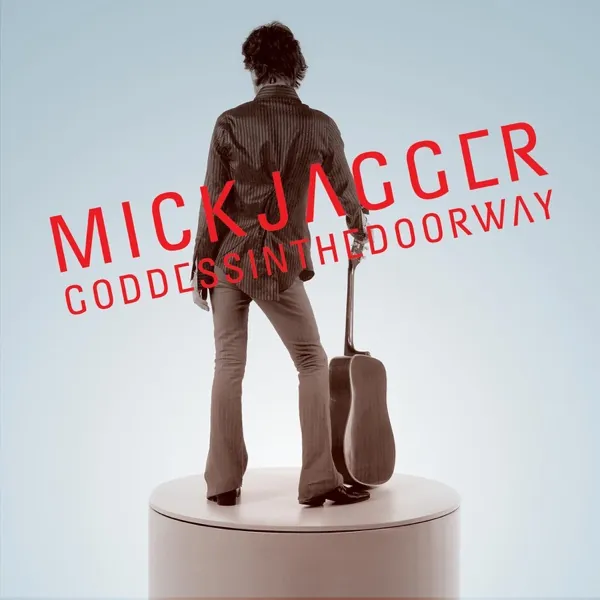
Jagger the Pilgrim
Mick Jagger's solo career has been a disappointing affair. I listened to 1985's She's the Boss, 1987's Primitive Cool, and 1993's Wandering Spirit, but it is telling that I can't remember a single song from any of them.
Jagger's strengths have always been his stage presence, his compelling charisma and bizarre, extreme expressiveness. His vocals are all about attitude, his face a series of exaggerated masks--the proud sneer, the sly seducer, the boastful hedonist. He has enough ego for a whole band, and yet, without his trusty Rolling Stones behind him, he's seemed unsure who he is or what he has to say.
But on his new solo album Goddess in the Doorway, Jagger does something quite startling. He takes off the mask and, perhaps for the first time in his whole musical journey, allows himself to be vulnerable. While his lyrics have usually been more about attitude than art, here he offers some surprising (if somewhat conventional) metaphors in an attempt to articulate more spiritual sentiments. He's stepping beyond his usual boundaries and exploring territory more suited to spiritual troubadours like Mike Scott of the Waterboys, Lenny Kravitz, Bono, Sting, and even Dylan.
The album's opener, "Visions of Paradise", is a playful, boisterous anthem about romantic love. But it's just the beginning, the first step to something higher. The refrain is one of resistance--"Don't put your arms around me /Don't hold me tight / 'cause I could get used to your visions of paradise." The singer clearly knows the "downs" of love better than the "ups", and thus he's become hesitant and reluctant. Is this the same Mick Jagger? The music gives it a strong optimistic tone, opening the singer slowly up to bolder confessions.
That's when the surprises begin. Goddess in the Doorway is an album of blunt spiritual confessions above all. Musically, it's simple and straightforward, and a little too glossy and studio-produced to properly accommodate such candid stuff. But the lyrics are specific enough to imply that this is the real Mick Jagger speaking up, spilling his guts.
It's hard not to think of Bono, lead singer of the only band of the 80s and 90s to come even close to the stature of bands like the Stones, the Who, and the Beatles. Bono has done his fair share of strutting and crowd pleasing, but he's done it with bold soul-searching lyrics and a persistent emphasis on prayer and Christian pilgrimage. In troubled times, we are seeing U2's music grow in vitality, comforting and lifting people's wounded spirits, while the Rolling Stones remain anthems of ego, attitude, and indulgence. Perhaps Jagger is taking a cue from Bono, and trying to step up to a higher sort of performance.
Thus, it's quite fitting that Bono himself shows up in "Joy". The song might as well be a tribute to U2, with its resonant power chords and choral finale. Unfortunately, it doesn't quite work. Bono's backup vocals indicate what Jagger's trying to reach, but the song falls short. The lyrics are blatant, obvious, devoid of poetic imagery that would draw us in and lead us to the joy he seems so excited about. As Jagger tries hard to tap into old-style Sunday morning glories with a spirited black gospel choir, Pete Townshend's classic-rock guitar hook just doesn't fit. It's too jarring a juxtaposition. Still, it's good to see Jagger, who has made a career singing about carnal connections, recognizing the need for something higher and making a start. He sings, "I looked up to the heavens/And a light is on my face/I never never never/Thought I'd find a state of grace."
The follow-up offers more provocative pictures: ships lost at sea, shadows appearing on a wall, and a personal quest to find salvation. Looking for salvation is quite a different quest than looking for satisfaction... one is a child's quest, a prodigal son's vain hope, while the other is a mature longing... in fact, you could say one is the destination of the other. By identifying his quest as a spiritual one, Jagger has graduated.
As if to dispel any doubts about the fact that he's finally grown up, Jagger offers "Everybody Getting High," a tongue-in-cheek reminiscence of his younger foolishness. He even pokes fun at his famously sleazy fashion sense. No, the old Jagger is gone, he insists, and the new one is living by "Brand New Set of Rules" (the closing track.)
Fortunately, he hasn't left behind what made the Rolling Stones so important...that fundamental groove. Jagger's rhythm guitar can still let loose with predictable but irresistible hooks, the sort of dance-driven rock that has kept the Stones on the radio for decades.
And he invites other grand ego-rock guitarists along to keep things lively. In addition to Townshend's appearance, Lenny Kravitz turns in some scorching chords on the album's strongest track, "God Gave Me Everything". There, Jagger's lyrics remind me of the signposts to which C.S. Lewis and G.K. Chesterton directed us... those echoes of God in all good things. Each earthly gift is good, but it also points us to the Giver, the source:
You can see it in a clear blue sky
You can see it in a woman's eyes
You can hear it in your baby's cries
You can hear it in your lover's sighs
You can touch it in a grain of sand
Yeah hold it right there
In the palm of your hand
Feel it 'round you everyday
And hear what I've got to say
God gave me everything I want
Come on
I'll give it all to you
God gave me everything I want
Come on
I'll give it all to you
In "Hide Away", Jagger sings about a longing to disappear, perhaps from celebrity, perhaps from his past, perhaps from this life. It has a trace of the bliss-bound sentiments of U2's "Where the Streets Have No Name", affirming that the singer is prepared for a permanent spiritual retreat. And it's hard not to wonder if the song isn't the fruit of Jagger's own meditations on death, which might not seem very far away for a middle-aged man who has lived as recklessly as he has.
I've never been much of a Stones fan. Their narrow focus on carnal appetites confines them to the surface levels of rock and roll. But Jagger, at long last, has finally taken up a shovel and started digging, offering some of his regrets, his wounds, and realizing at last his deeply buried need. If he keeps at it, he may well strike gold.
3.5 tocks
Other coverage for this album
The Phantom Tollbooth March 2002Reviewed by Jon SingerRock icon Mick Jagger releases his fourth solo album, Goddess in the Doorway, as an attempt to mark his place in the new century. Jagger, the Rolling Stones' frontman, last recorded a solo album in 1993. On Goddess in the Doorway, he experiments with pop production that has become commonplace since then. To modernize the album, Mick Jagger first wrote drum beats to go along with his lyrics. He…Similar sounding releases
 1996NewsboysTake Me To Your Leader
 1998DC TalkSupernatural
 1997PFRThe Late Great PFR
 2000Aaron BenwardImagine
 1999Audio AdrenalineUnderdog
 2002Ashley ClevelandSecond Skin