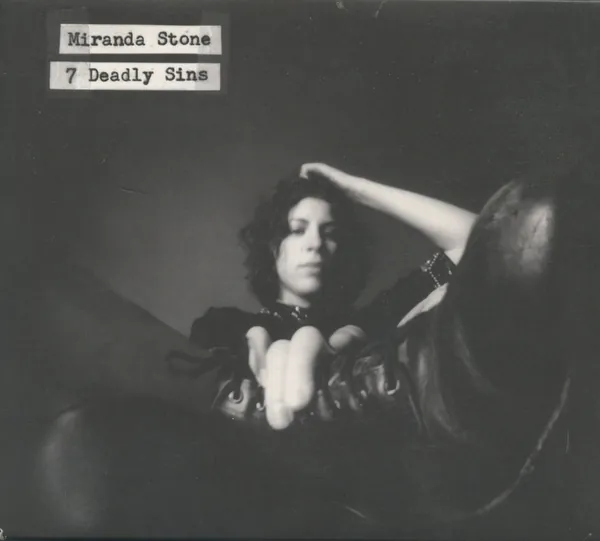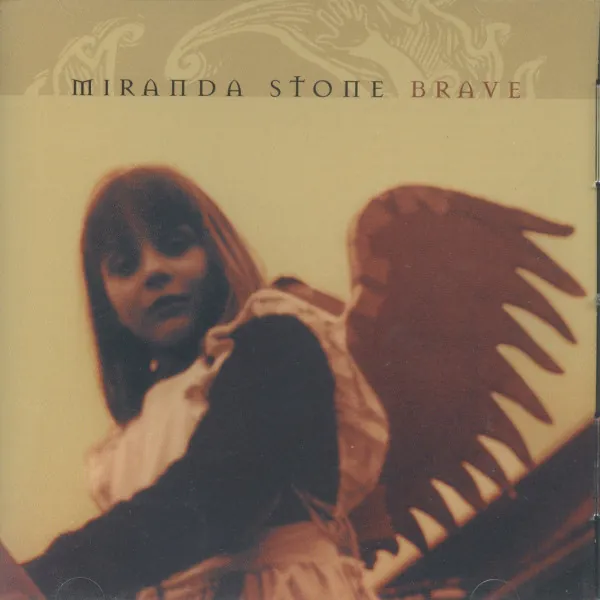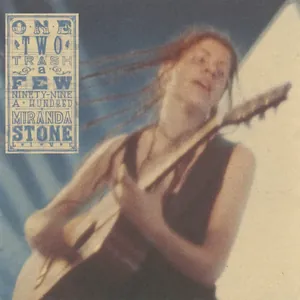
Miranda Stone describes her work as "folk punk," which by itself sets her apart from the mainstream. I will leave any lengthy pondering about what that implies to folks who take music genres very seriously. Judging by her first two albums, Miranda Stone means by "folk punk" lyrics and music that is very direct, unpolished, and takes on life head-on with little in the way of pretense.
Ms. Stone's latest album is, like the first one, a self-produced independent album. She wrote all the songs and liner notes, and even took some of the photos. It was recorded live. Stone acknowledges that it is more usual to release a live album after several studio albums and touring. "But," she continues, "I don't have that kind of time."
Such control over the album could easily degenerate into self-indulgence, but Stone's quirky sense of humor and ability to laugh at her own foibles prevent that from happening. The album leads off with Stone introducing herself, and saying "We are ready to rock." The band then launches into the first song, only to stop after a few notes because she had forgotten to put the capo on her guitar. The main impression the listener gets from listening to this album is that it is fun to catch Miranda Stone in concert.
The songs on the album have an unpolished feel. Stone's songs are decidedly not pop tunes. Some of the songs sound as though the lyrics were written separately from the music and were combined almost arbitrarily. Stone even mixes metaphors of a sinking ship and mailing letters in "Never Lick the Stamp," without any clear connection between the two.
It is not unusual for the end of one of Stone's lyrical lines not to fit neatly into the musical phrase. Verse lengths vary, in songs like "Follow," and "Never Lick the Stamp," according to the thoughts expressed rather than a formula. This gives the songs a conversational feel, especially when combined with the focus on everyday life in the lyrics. Love and loss, nostalgia for childhood ("Fields of Joy"), lack of communication and its consequences, even bad gigs ("House of Ill Repute"), all figure in Stone's songwriting.
The lack of polish is not always a liability; the more poetic lines and images stand out in contrast. "3 Stories" is a notable example: "The dying son of man who kept silent for his cause when everyone he loved scorned everything he was. The plight of separation when hearts have turned to stone And winter coats won't save us from how cold we have grown."
The musical styles are eclectic. On one end of the spectrum, there are simple folksongs like "Brave," with its fingerpicked guitar and simple vocal (The album contains two versions of "Brave," a live version and a bonus track recorded separately in the kitchen of one of the album's engineers, with cello added to the guitar.) On the other end, there are songs like "Follow," or "Break Out of Line," with 70s rock guitar, bass and drums. "Break Out of Line" slips into disco in the middle of the song. Fiddle, mandolin, and accordion weave in and out of songs. An African drum group plays and sings in "Never Lick the Stamp."
Stone's energetic vocals slip back and forth between her natural alto range and a Jan Krist-like falsetto. There is an insistence and urgency in her phrasing that conveys a passion not often heard on the radio. Stone can also switch gears and sing softly and plaintively, as in the song "Brave."
In addition to the songs, Stone chose to include several short snippets of her between-songs chatter, which she acknowledges usually consists of saying the first thing that comes into her head, and running comments from her band, the album's engineer, and even the audience. The last track on the album, "Mr. Bad Cold Germ," is a strange mixture: readings by a band member from those earnest books on hygiene aimed at schoolchildren, some of Ms. Stone's between songs chatter ("Did you ever squeeze your hamster?"), a tender folk tune in which she mocks herself for missing a chord, and the bonus version of "Brave."
The humor and interplay between Ms. Stone, the band, and the audience are authentically captured on this well-engineered album. The prospect of what a label's recording budget could do for her music is tantalizing, but such an investment is unlikely, forcing listeners to settle for recordings made on limited budgets. As long as Ms Stone does remain independent, catching her in concert may be the best way to hear her, which makes this a good album to own.
3.5 tocks
Other coverage for this album
7ball #31Reviewed by UnknownMiranda Stone uses her brand of alternative folk to write about the experiences of herself and those around her. "I want the Spirit of God to be very, very present in the music I'm doing," she told The Phantom Tollbooth. "But even offstage I want to be able to communicate and have it shine out my eyes."The Phantom Tollbooth 1999Reviewed by James StewartTo those who subscribe to music industry conventions, Miranda Stone has it all wrong. A live album is a project that should only take shape when a fanbase has been established through the marketing of several albums. But Stone's fanbase has been established through frenetic live shows, and sidestepping industry conventions is an integral part of how she works. At her Cornerstone press conference,…The Phantom Tollbooth 1999Reviewed by Israel KlossMiranda Stone has done it again. Her sophomore release provides some kickin' live tunes that match the excellence of her debut five-song album, Brave. There are at least two songs on this new album that may even exceed the originality of her freshman album. Stone's voice is, again, the passionate focal point of the album and it sounds better than ever. It has the same bull-in-a-china-closet…Similar sounding releases
 2001Mark ProtusThe Future That Used To Be
 2002Set On EdgeA Story To Cling To
 1998DanielsonTri-Danielson!!! (Alpha)
 1998Larry NormanCopper Wires
 2005Ed EnglerthD.I.A.L. Business
 1998Mule DavisMule Davis