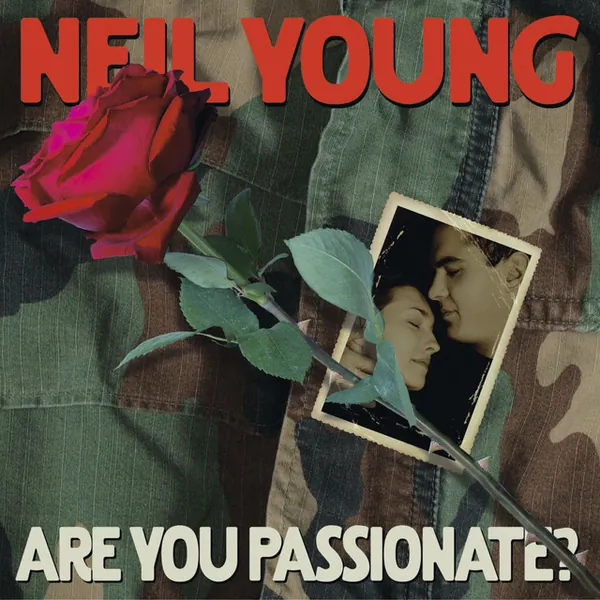
I can't imagine Neil Young being any less passionate than the day he received his first instrument, a plastic ukulele given to him by his parents as an early Christmas present back in 1958. I was trying to figure out what the line, "I stopped to slap plastic at an Esso station" referred to in "She's a Healer," the lenitive nine minute song at the tail end of Are You Passionate? Perhaps he ran out of cash before running out of gas, and so he entertained the gas attendants with his plastic ukulele in exchange for some gasoline. On second thought, it is doubtful that he held on to that childhood instrument for that long. What he did manage to hold onto is his passion, and that passion has never been in such abundant supply as it is in his latest humble offering, the destined-to-be-a-classic Are You Passionate? Incredulous skeptics take heed! Young's reunion with Booker T and the MG's, whom he toured with back in '93 will certainly add fuel to passion's fire, that's guaranteed!
Are You Passionate? is a creative confluence of myriad sides of Neil Young. Yet it is more a graceful dance between letting go of and holding onto the past than a precipitous shift towards regression. The album is relatively scaled down in terms of arrangement - no electronic, synthesized influence like he and his son, Ben, were experimenting with in the early '80s. (Ben, by the way, is a talented artist in his own right. He shared some of his own creative avenues with me at a party I attended in Los Angeles in the early 90's).
At various points in Are You Passionate? there is a conspicuous cross between the rusticity of Crosby, Stills, Nash and Young and the free spiritedness of Buffalo Springfield. In terms of past Young albums, Are You Passionate? comprises more of the warmth and intimacy of Harvest than either the punk edginess of Rust Never Sleeps or the guttural grunge of Mirror Ball (which features Young's priceless gem of a jam session with Pearl Jam). Yet traces of all three are appreciably apparent.
The album title assigned to this intimate musical portrait is as inviting as the heartwarming first track, "You're My Girl." This song marks the crucial turning point in every aging father's unfolding saga when he must confront a daunting developmental task - that of letting go of children who are facing daunting developmental challenges of their own. An aging father's growing awareness of the need to shift from a highly involved to a more removed role in relation to his children is often accompanied by a plaintively painful sense of loss. Such a developmental milestone also serves as a sobering harbinger and a stark reminder that everything eventually changes, and then passes away. This ultimate realization is accompanied by what the renowned existential philosopher Rollo May (I call him Rockin' Roll-o May) called ontological anxiety, or the fear of nonbeing.
Are You Passionate? reveals in preciously vulnerable terms, a dramatic psychological tug of war between warring worlds. These worlds are identified by May as Mitwelt (the social world of other people) and Eigenwelt, (the psychological world of one's self, potentials and value). Are You Passionate? is, for all intents and purposes, a concept piece revolving around the struggle between holding on and letting go of possessions, people, and both pleasant and plaguing memories. Letting go with a fight is part and parcel of passion. In some ways, it would be easier not to form intimate attachments at all - not to feel. Life would be so much simpler if we could all act like the main character in Simon and Garfunkel's classic song "I am a Rock." "Mr. Disappointment," the album's sophomore track, is a bittersweet tale of an archetypal journey - one marked by innocence and naive expectations headed on an ineluctable collision course with disappointment. As Mr. Disappointment rears his ugly head in this song, it seems that the greeter who shakes his hand is wearing boxing gloves. This is abundantly clear in the line, "I miss the feeling/I miss the light/but I got faith in something/I'll never give up the fight." To surrender without a fight is to die without ever really living. At least that's something the great existential theologian, Paul Tillich would readily agree with, as would the apostle Paul, who repeatedly and passionately pleaded with members of the church in Corinth to press on in the face of adversity.
To borrow a couple of stages from Abraham Maslow's Hierarchy of Human Needs, "Let's Roll" is a wake-up call that abruptly shifts the attention of the listener away from "belongingness and love needs," towards "safety needs." It is a solemn and stirring tribute to Todd Beamer, the American hero who boarded Flight 93 on September 11, 2001, in what would turn out to be a valiant confrontation with terrorists. With the words, "Let's Roll," Beamer set out on a mission to thwart the insidious plans of terrorists to use this common vehicle of transportation as a plane-shaped weapon of mass destruction. According to all available evidence, their "bomb" was aimed at Washington DC.
Young does a little time traveling on "Goin' Home," but not without a little help from his friends, who just happen to be the reunited members of his band, Crazy Horse. The journey begins "On the hill where Custer was making his last stand." The primal guitar chords and hypnotic pounding of the native drums transport the listener from the past to the future. There we find a woman turning "on a wooden bridge into the battleground/She tried to turn her radio down/Battle drums were pounding all around her car." In the end, "she saw her clothes were changing into sky and stars."
The archetypal struggle between letting go and holding is revisited in "When I Hold You In My Arms." Young displays a distinct mastery of metaphor in the line, "New buildings going up, old buildings coming down/you've got to hold on to something in this life." The dance between holding on and letting go is further noted on Be With You, where Neil sings, "I got to hold on/I got to be strong/I got to live long and be with you."
The aforementioned metamorphosis encountered by the woman introduced in "Goin' Home" (the one in which "she saw her clothes were changing into sky and stars"), foreshadows a divine encounter between a preacher and God in the song, "Two Old Friends." The preacher, "with the glow of love in his flowin' hair" shares his dream with God: "I'm dreamin' of a time when love and music is everywhere." The preacher in this song sounds like an older Young pining for the innocence of his younger years. Back in the days when Stephen Stills was still jamming with then future Monkee, Peter Thorkelson, and Young was touring the Winnipeg folk club circuit with his folk-rock trio, The Squires, his evangelistic zeal and quixotic dreams were all he had to hold onto. Like the preacher in "Two Old Friends," Neil longs to "see no evil/hear no evil/feel no evil." The Vietnam war robbed him of his roseate sun glasses. Neil would live through that period and come out with a "Heart of Gold," an accurately descriptive summary of the state of his heart and the title of his first number one hit song. As the years have gone by, Neil has survived and rose above a whole lot more than Vietnam - including September 11. As long as he is around to gracefully interpret the most traumatic of events in his own uniquely personal way, we will all survive.
Someday I hope to interview Neil Young for my Rock 'n Role Models series. If fate ever deals me such a benevolent hand, I know I will not have to ask my fellow native Canadian artist what he has asked us all, Are You Passionate? But the CD does leave one burning question on my mind that I will be sure to ask him, "I've heard of burning rubber, but what does it mean to "slap plastic?" Are You Passionate? is actually an album of questions, born out of a state of artistically pensive introspection.
Years of ups and downs have caused Young to question the past, the present and the future. But his music is timeless, and whether rolling up or down hill, the man who put the "rock" in folk-rock keeps gaining momentum. One of his first gigs was with The Jades, but he wasn't jaded then, and he is not jaded now. While many of his colleagues have faded away, Neil Young just keeps on breathing new life into the world of music. When the artist formerly known as Cat Stevens used to sing, "Oh very young, what will you leave us this time?" I couldn't help wondering if he was unconsciously revealing his eager anticipation for the release of Young's next album. I keep anticipating more and more intimate, bold, and fresh creations from Young - and I have yet to meet Mr. Disappointment. Young's desideratum is simple and pure. He spelled it in the opening line of "Heart of Gold" - "I wanna live. I wanna give." Neil Young has done plenty of both and the water that flows from his stream of life is fresh and in abundant supply. As the record industry reels on the heels of one of the worst commercial slumps in recent history, talent scouts are looking for younger and younger stars to brighten the horizon. But who needs a fountain of youth when you've got a fountain of Young? Who needs a fountain of youth when you've got Are You Passionate? - living proof of a prolific artist and articulate purveyor of timeless truth?
4 tocks
Other coverage for this album
The Phantom Tollbooth 2002Reviewed by Steve StockmanReceiving bad reviews in the press, Stocki listens to the new Neil Young album and finds a lot he likes...he's not sure he said it as well as he'd have liked but he said it... I cannot remember being more excited about the release of a Neil Young album and I have been buying them as they have been released since Comes a Time in 1978. The reasons are many. Firstly I spent last summer immersed in…