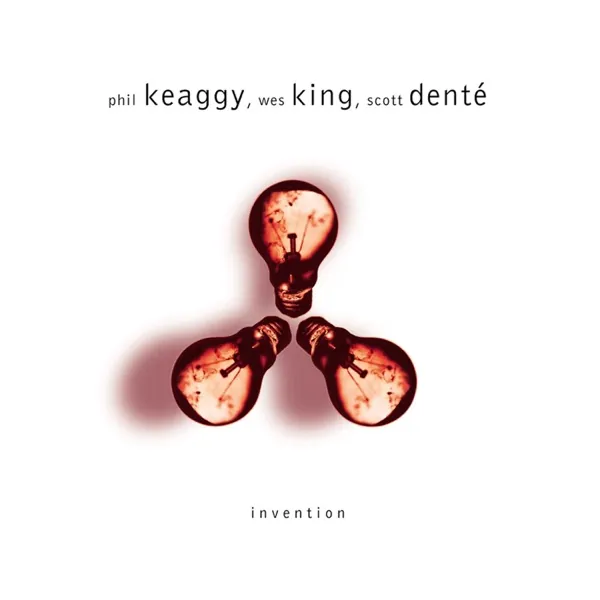
Well, here's an interesting gem of an album that I overlooked when it first came out. On the day my girlfriend and I got together, she gave me this CD along with a few other thoughtful gifts. Entitled Invention, this album represents the latter half of an experiment by Sparrow Records in the mid 90's - the collaboration of three artists on their roster. The first installment, Along the Road, came in 1994, featuring the vocal talents of Susan Ashton, Margaret Becker, and the lovely Christine Denté, lead vox for Out of the Grey. The joke was that OOTG's guitar player Scott Denté felt left out, what with his wife recording a project without his help, and so he was going to retaliate by recording an album with label mates Carman and Steven Curtis Chapman. Thank God that never came about - Scott and SCC would likely have come up with some wonderful guitar madness, but Carman would have wrecked the whole thing! Anyhow, in 1997, two other renowned guitarists instead became available to work with Scott - Phil Keaggy and Wes King. Thus, Invention was born.
I passed Invention by when it first came out because I knew most of the music was just instrumental guitar stuff. I wasn't into that. Fast forward past my college years and now I'm a guitar player. My girlfriend, being the clever and observant individual that she is, figured I'd appreciate the album more than she did, and so I now have it in my hands, and it has the rare honor of getting regular rotation in my CD player even though it's five years old. Out of the Grey has been one of my favorite artists ever since I got into Christian music eight years ago, though my one complaint was that their shiny brand of radio-friendly pop hardly ever gave Scott a chance to truly shine. Invention gives him that chance, though admittedly he's found himself in the company of two guys who outrank him in terms of popularity. I've never really gotten into Wes King or Phil Keaggy beyond a few songs here and there, but I do recognize their appeal as guitarists and songwriters, especially in the case of Phil (there's an urban legend floating around - supposedly when Jimi Hendrix was once asked what it's like to be the greatest guitarist in the world, he said, "I don't know; ask Phil Keaggy.")
For all of the talent present on this record, it doesn't immediately jump out at you with a number of self-indulgent guitar solos and other instrumental pyrotechnics. The prevalent style here is definitely pop/rock, but nothing heavy enough as to scare off the largely adult contemporary crowd that generally listens to these three gentlemen. What we've got here is a glimpse of what these three would sound like in a more spontaneous setting - a jam band, if you will. And despite a few missteps (most notably when the guys attempt to write lyrics for the sake of radio playability), it's a pretty tasty record, offering a healthy balance between acoustic and electric guitar playing, and giving each of the guys a chance to show us what the light bulbs above their heads are made of.
"Watch My Back"
You and me, we always had to fight for what we got / We cried out tears, but we laughed a lot
Oddly enough, the album starts out with the guys harmonizing as if they were the Beatles. Of course they can all sing - Phil and Wes normally do their own vocals, and Scott's been known to take the lead on an occasional OOTG number - but it's a funny way to open a "guitar album". Wes King takes the lead on this song (he wrote it all by himself), which turns out to be a light-hearted ode to friendship and accountability. A little cheesy, perhaps, but you can almost see a big smile on the three guys' faces as they sing and play, as if they'd been best friends since childhood. The vocal harmony that opens the song later becomes the tune for Phil's electric guitar solo - he gets the distinction of not only anchoring the song down with his bluesy guitar licks, but playing bass as well. Wes plays no less than three guitars on this track, while Scott sticks to his acoustic. It's a fun song, especially when the guys poke fun at their own lyric by randomly asserting near the end that "watching" someone's back is "not to be confused with washing."
"Isle of Skye"
The record's first instrumental track fares quite well, loping along on its 3/4 rhythm as Scott's circular acoustic guitar melody leads the way. Wes contributes a mandolin to the track, which adds a bright splash of color. That and the title evoke an image of a medieval festival - remove the electric guitar and bass, and this might be something you'd hear at a Renaissance Fair.
"The Moors of Bellevue"
Electric guitars confidently take the lead on this song - perhaps one complaint I have about this album is that there's not enough acoustic guitar wizardry (but I'm biased 'cause that's what I play). Phil and Scott are the driving forces here, wielding a Fender Stratocaster and a Gibson ES 135 Electric, respectively (no clue what the subtle differences between all of these guitars are, but enthusiasts will likely drool over the detailed lists given in the liner notes), and their playing sticks to a fairly straight-ahead rock progression. It's a catchy tune, but it gets a little repetitive after four minutes, since the underlying chord sequence is fairly basic. Probably one of the more "show-offy" tracks on the album - it's fun to rock out to, but it's not full-throttle head-banging music or anything.
"River of Life"
I watch you dancing inside your wide-eyed world / Your heart is a flag unfurled
Phil's attempt at songwriting turns up here - while I've always liked his quirky and somewhat high-pitched voice, I can't say that this is one of his better lyrics. You can tell from the title that the song takes a more typical CCM approach - Phil's lyric pleads with a non-believer to come to the "river of life" and find healing. This was probably a result of Sparrow intervening and saying they'd fund the record if the boys gave them a radio single. It's as if the record wouldn't have qualified as "Christian" without such a song. Phil does some interesting things with the melody, but ultimately, it's not enough to save the song from mediocrity.
"Budapest Control"
I love these titles. They're nonsense, and yet they're so descriptive of the song's character, really helping every track to stand out despite the abundance of instrumental work. The shaking of a tambourine (the guys do have a little outside help with the percussion) helps to add to the mystical atmosphere that transports the listener to a gray, overcast location in Eastern Europe. Phil tickles us with some E-bow guitar playing on this track, and overall, this one's got a really good balance between the acoustic and electric elements.
"Angel Treads"
My favorite track on the album - partially because it's a heavenly sea of acoustic guitars with light percussion, and partially because anything with the word "angel" in it makes me think of my girlfriend. Thank God this one doesn't have lyrics - they'd probably be on the mushy side. I just love everything about this tune - its approach is gentler than anything on the album so far, but it makes up for that with a delicious melody, and gives all three guys a chance to shine. You can just picture those fingers flying across the strings as if these guys were born with guitars in their hands.
"More to Be Revealed"
And though I've caught a glimpse of what I could be / It's gonna take X-ray vision to see through me
Scott gets his turn at the mic on this one, and it's probably the strongest of the four vocal tracks. Maybe I just think that because it's not very often we get to hear Scott sing without Christine (who has one of the loveliest voices ever; Scott's is more earthy and husky). The music is more mid-tempo here, once again driven by the electric guitar, but it's a powerful tune once it builds up steam. Scott is pleading for God to destroy the walls he's built around himself so that he can be easily transformed into the person he's supposed to be. Nothing terribly profound, but I do think Scott's got the best pen (and voice) of the three guys.
"53 Days in June"
This tune is pretty much all Scott - he has a certain percussive, funky style to his strumming that manages to be distinctive to those who have an ear for subtle guitar nuances. Don't ask me where they got the absurd title - perhaps the album was recorded in June and Scott felt like it took forever to finish. Anyhow, this tune is somewhere between "Isle of Skye" and "Budapest Control" in the foreign atmosphere it creates - I love that he includes a sitar on this track! It runs for over five minutes but it never gets boring, due to the layered electric, acoustic, and sitar playing, jamming along with the solid drumming. I could sit and listen to this man jam for hours.
"Perspicuity"
That's "Perspicuity", not "Promiscuity". Get your mind out of the gutter! The boys take a bit of a jazzy turn here - everyone participates, but I get the feeling this is Wes's turn to steal the show. It's another composition in 3/4, but this one's got a bit of sass to it as it seems to cut itself off and jump back to its home key at odd intervals. It's hard to explain, but it's another one of those tracks that gives a great mental picture of the guys sitting around, making stuff up on the spot, and competing to see who can invent the weirdest title for it. Listen closely and you'll hear Phil Keaggy singing along to the main guitar line. (See? I'm not the only one who does that!)
"The Quote Jester"
The album's penultimate track (also its shortest) is nothing but Phil noodling around on his Paul McGill Resonator Acoustic. What he's basically doing here is playing a musical game of Simon with himself - he recorded himself playing a rather difficult finger-picked solo for two minutes or so, and then played it back and challenged himself to play the exact same thing. The results are separated out into the left and right audio channels - though you wouldn't know this without having read it, since he mimics himself almost flawlessly. At times you can tell there are two guitars at work, but sometimes it just sounds like he's hitting two strings at once (I'm sure he's doing that too). No easy feat, since he often deviates from any sense of rhythm altogether and just goes flying across the fret board, much like the break near the end of Extreme's "More than Words". All this from a man who only has 9 fingers!
"Something, Somewhere"
Call me something you understand / But you cannot hammer down a journeyman
The album's final track tries to be a barn-burning rocker, but kind of falls flat due to a mild-mannered tempo and frustratingly vague lyrics. All three guys take their turns at the mic here, and the result is actually rather odd for a "Christian" album, with lines such as "I would like to say that there is just one way/And I'm sorry, but I can't". Actually, I'm pretty sure that refers to people's attempts to define the guys as musicians, and not to their faith - it's a statement that they don't want to be so easily categorized (interestingly, they've all left the label since then, resurfacing on labels that offer a lot more artistic freedom). It's a nice thought, but the chorus is rather inane ("I am neither this nor that/I'm not here or there/I am in between something/Something and somewhere"). I guess I would've preferred to end the album with another luscious acoustic number - but I'm no wizard on said instrument, so perhaps I should shut my mouth.
Invention is a fun diversion for guitar enthusiasts, though it might be difficult to find these days. Due to the instrumental-heavy nature of the record, I wouldn't expect most typical CCM fans (even those who follow the guys' respective solo careers) to enjoy it, but I think guitar players will love it, Christian or otherwise. It's not the be-all and end-all of cool instrumental albums or anything, but it really makes me hope some more guitar breaks start showing up on Out of the Grey albums one of these days.
David's Score: 4/5
Other coverage for this album
The Phantom Tollbooth 1997Reviewed by Lisa ReidIt should go without saying that this CD is a must-buy if you are a big guitar fan. Phil Keaggy is a legendary guitar player of long-standing reputation in the Christian music industry, and is well-known for experimenting with different styles. Wes King and Scott Dente (known for his work with Out of the Grey) are also strong guitarists in their own right. When these three men come together on…The Phantom Tollbooth 1997Reviewed by Shari LloydFrom the artist roster, it appears someone held a party and invited their favorite guitarists--Phil Keaggy, Wes King, and Scott Dente (Out of the Grey). Not a bad idea. I wonder what they told them to bring? They seem to have showed up with an extraordinary number of different guitars, a couple of drummers, and an occasional bass player. I quit counting the guitars after twenty. It's clear to see…Similar sounding releases
 2000Andy ThorntonThe Things You Never Say
 2001EliNow the News
 2003Joel SprayberryEverybody Needs a Tuba
 1995Michael RoeSafe as Milk
 2011John JanzenThink Again
 1996Vigilantes of LoveV.O.L.
More from Phil Keaggy
 1999Music to Paint By - Brushstrokes
 1988Electric Guitar Style (Video)
 1990Find Me in These Fields
 1994Blue
 2001In the Quiet Hours
 1995Time 1