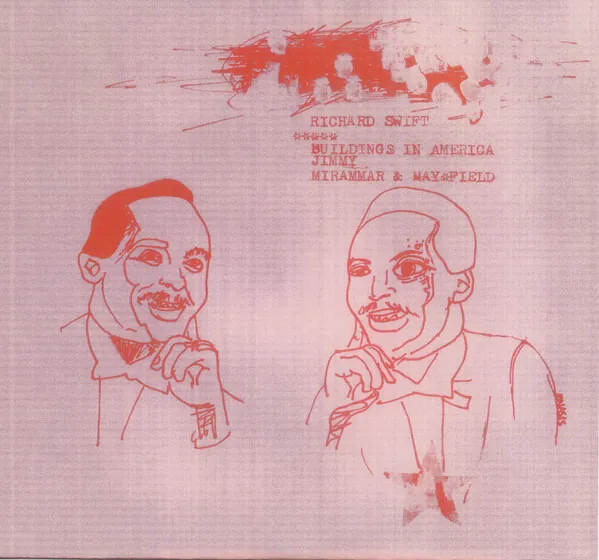
Despite its virtually unabated mainstay status among those in the dance and hip-hop genres over the course of the past two decades, the vinyl record, for members of the rock and pop communities, has all but faded from view, having been relegated to a small, but devoted, contingent of mostly independent and underground punk and alternative artists. Given keyboard wiz Richard Swift's distinctly indie aesthetic and decidedly less-than-household-name status, the decision to place his debut three-song single on the stalwart analog medium seems, all things considered, an only fitting one.
For his freshman outing, Swift, whose musical resume includes in-studio contributions for the likes of Bon Voyage, Pony Express and Duraluxe and a current slot as touring keyboardist for Starflyer 59, enlists the help of fellow auxiliary musician and kindred spirit Frank Lenz of Cush and Fold Zandura renown. For the lead-off track, "Buildings In America," the duo ties together plaintive, languishing vocals, a la Tom Petty's slower works, with delicate, '70s-infused melodies and chord progressions and crowns the resulting combination with a slightly obscure wording (Please remember/ To regret it/ Don't be sorry/ Just forget it/ And please don't laugh/ If I can't say your name) that calls to mind REM's most engaging early and mid-'80s works.
If "Buildings in America" finds itself lyrically rooted somewhere between Murmur and Life's Rich Pageant, its B-side, "Jimmy," falls more in line with REM leader Michael Stipe's essays on living and dying from his group's 1992 masterwork, Automatic for the People. Indeed, the sweeping orchestral treatments and near stream-of-consciousness phrasing (Crazy eights/ Go fish/ I made a pond/ I wondered, were you sad?) of the haunting Swift composition seem nearly of a piece with songs like "Nightswimming" and "Sweetness Follows" from Automatic. And the beautifully ethereal tune, originally written in 1993 by Gene Eugene as an ode to a recently deceased friend, inherits an added poignancy and weight in light of Eugene's own untimely death in March of 2000 at age 39.
It seems a safe bet that "Mirammar & Mayfield," a brief series of random musical segments, sound effects and barely discernible conversation snippets harking back to the "Revolution 9" track from the Beatles' White Album, will likely be consigned to no more than a handful of spins by most listeners. But while the fleeting clip could certainly have been dropped from its tacked-on slot at the back end of "Jimmy" with no deleterious effects to the single as a whole, the remaining two songs nonetheless manage to carry the proceedings in exceedingly fine form. To be sure, Swift and Lenz's collective labors have produced a unique and alluring serving of first-rate alternative pop/rock. Here's hoping that the next slice of vinyl from Swift and his compatriots comes in the 12-inch variety.
4 tocks