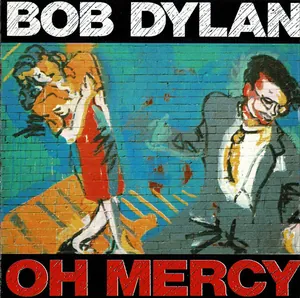
Bob Dylan is a genuinely intriguing man. 1989's Oh Mercy is a compelling, multi-dimensional collection of some of Bob's most underrated songs of all time. It's an album that always seems warmly familiar and, at the same time, eerily compelling to me. It's a moody, sometimes bitter piece, but it's also Bob Dylan at his most vulnerable and joyous.
Before we dive into the actual album, though, let's get a few things straight about the enigma who is Bob Dylan...
The Anatomy of Bob Dylan
1. Bob Dylan is a poet. His words have had profound influence on multiple generations. Bob's lyrics are at once deeply personal and remarkably universal, very human, yet very spiritual, intricate, witty, creative, relevant, and deep. Dylan is easily one of my favorite lyricists.
2. Bob Dylan is a powerful vocalist. He's not a singer, mind you. In fact, the first time I heard Bob's voice, it made me want to hang myself. Once you get used to him, though, Bob's emotive singing is strangely intoxicating.
3. Bob Dylan is a musician. He's famous for being a capable guitarist and harmonica player, but he also plays piano multiple times on Oh Mercy. His skills as a pianist are impressive - perhaps he should tickle the ivories more often.
4. Bob Dylan is a legend. He's been around longer than the Beatles, he's made forty albums, and he has permanently changed the face of music. Bob Dylan has created a formidable legacy... and he's not done, yet.
Oh Mercy!
I don't own all of Bob's records, but, from what I've heard, Oh Mercy is easily my favorite Dylan album. It has a blatant spirituality to it, but it's not preachy or heavy-handed, like Bob's 1979 album Slow Train Coming. This album is among Dylan's most creative and diverse. It finds Bob offering cynical social commentary, lamenting over a lost love, and playing with more conviction and energy than most Dylan fans are accustomed to. Most Dylan fans will point to some of Bob's older albums as his best, but Oh Mercy is still my personal favorite.
"Political World"
The opening track is among the shortest and most fast-paced on the album. It's a snappy little number, driven by some of the quicker, murkier, intricate guitars and percussion that are more commonly associated with Bob's newer work, but also seem heavily influenced by good ol' American blues. This track basically serves as Bob's commentary on the state of the fallen world we live in, a place where "peace is not welcome at all" and "wisdom is thrown into jail." As usual, Bob is addressing a serious topic without forgetting his dry sense of humor and sarcasm.
"Where Teardrops Fall"
This song is the first of many slower, bluesier numbers on the record. Placing such a slow tune at the beginning of an album is a bit unorthodox, to be sure, but then, Bob Dylan is a rather unorthodox guy. The lamenting guitar riffs on this one remind me almost of something you'd hear on an "oldies" radio station, but the lyrics are far too sober and moody to fit in with the Beatles and the Supremes. Bob seems to be addressing an old friend here, as he says, "I just might have to come see you/Where teardrops fall."
"Everything is Broken"
Think of this song as a continuation of "Political World." The acoustic guitar licks here are dreadfully catchy, and the mood of the song almost sounds like something from a James Bond movie. Most of the song is just Bob rattling off a long list poem ("Broken treaties, broken vows, broken pipes, broken tools, people bending broken rules..."). It's an interesting lyric, to be sure. The casual listener may find it to be rather silly and meaningless, but I think many of these "broken" things are symbolic. For example, when Bob talks about "people sleeping in broken beds," I think he's referring to a broken marriage, not a literal bed that has been snapped in half.
"Ring Them Bells"
This song is one of the most gorgeous on the album. It's mostly just Bob singing and playing the piano, with very little help from other musicians. This song contains much of the religious imagery that Bob is known for, but it doesn't come across as preachy or obnoxious at all (though we all know that Bob is very capable of being preachy sometimes). My favorite line on the whole album is in this song - "The sun is going down upon the sacred cow." Very clever, Bobby!
"Man in the Long Black Coat"
Intricate guitar work and a few sighs from harmonica create a thick atmosphere on this one. "Man in the Long Black Coat" gives me the impression of a hazy little Southern town, perhaps located near a swamp. Very few artists can conjure up pictures of a specific place in my mind, but then, very few artists are as talented as Bob Dylan. The mood of the song isn't half as interesting as the lyrics, though - Bob's wife/girlfriend/whatever seems to have left him. To make matters worse, "she went with the man in the long black coat." Oh, no! I hate it when that happens! Nothing boils my blood more than men in long black coats! Seriously, though, this guy is a fascinating, vivid character - Bob tells us that "he had a face like a mask" and "some people say from the Bible he quote." This song will have you trying to guess exactly who this guy is every time you listen to it.
"Most of the Time"
This one makes three brilliant songs in a row - way to go, Bob! This one is slower, more along the lines of "Where Teardrops Fall," and it finds Bob reflecting on a lost love, saying that, "I can't even remember how her lips felt on mine...most of the time." This is probably Bob's most vulnerable moment on the album, which makes it such a compelling song.
"What Good Am I?"
Here we have one of the darker songs on the record. It's also one of the most universally accessible, though. Bob asks himself (and us), "if I turn my back while you silently die, what good am I?" Ouch. This song hits pretty close to home with me. Bob's lamenting over his own complacency and failure to act on behalf of others. That's a very noble theme, not to mention very biblical.
"Disease of Conceit"
Bob Dylan never really gets preachy and self-righteous on Oh Mercy, but this song comes awfully close. Bob alerts us to the fact that, "There's a whole lot of people suffering tonight/ from the disease of conceit." That's very true, but Bob's delivery seems borderline arrogant. Oh well. It's really the only song on the album that isn't five-star material, and it's not a bad song, at all - just not as good as the others.
"What Was it You Wanted"
This song makes me laugh out loud sometimes. It's one of Bob's most witty, tongue in cheek songs of all time. It could be Bob angrily addressing a lover, but I think it could also be God sarcastically speaking to a demanding human, much like he did in the book of Job. Whoever the speaker is, he asks, "What was it you wanted?/ Could you say it again?/ I'll be back in a minute/ Try to get it together by then." Funny stuff, in my opinion.
"Shooting Star"
Oh Mercy ends all too quickly with the contemplative "Shooting Star." I really don't have much to say about this track, other than the fact that the lyrics are very poetic, and it's a fitting end to this beautiful album. "Seen a shooting star tonight, and I thought of you."
There's smoke on the water, it's been there since June...
Bob's quick wit and knack for deep poetry shine on Oh Mercy, but the thing that impresses me the most about the mighty pen of Bob Dylan is the fact that he can create such vivid atmospheres, people, and places with his words. Every track on the album suggests a very clear, believable location to me, whether it's the humid small town of "Man in the Long Black Coat" or the quiet hilltop of "Shooting Star." The characters are perhaps even more colorful. Again, the man in the long black coat always fascinates me, but he's not the only one - there's the sarcastic speaker on "What Was It You Wanted," the conceited man on "Disease of Conceit," and many others. Say what you will about his music, but you've got to admit that Bob Dylan is a talented lyricist.
Ring them bells, ye heathen...
A Bob Dylan record is always a satisfying adventure in listening. All of his strengths are especially evident on Oh Mercy - his uncanny sense of poetry, his impassioned vocals, his expert musicianship, his quick wit and knack for sarcasm, and his ability to incorporate the best of blues, folk, and rock 'n' roll into his music. Bob is now well into his sixties, but I, for one, hope that he continues to ring them bells and speak out as the poet of our generation (and the last generation...and the one before that...).
Josh's Score: 5/5
Similar sounding releases
 1970The Velvet UndergroundLoaded
 Glenn Schwartz and the All Saved Freak BandMy Poor Generation
 1971Glass HarpSynergy
 2003Luka BloomAmsterdam
 2002WilcoYankee Hotel Foxtrot
 1972AgapeVictims of Tradition