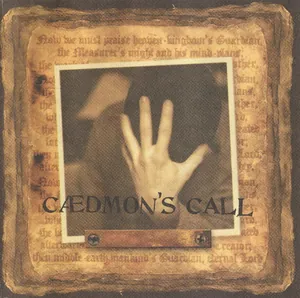
Christian music in the mid-nineties has been afflicted by a distressing decrease in the widespread availability of artists in the acoustic singer-songwriter tradition. With the death of Mark Heard, the closing of the Storyville label, and the relative silence of established artists like Rich Mullins, Bob Bennett, Billy Crockett, and Randy Stonehill, these have not been good years to find major label releases that cry to be strummed along with. But meanwhile, in basements and Bible studies across the nation, acoustic music is being created for the praise of God and the discussion of Christian issues. And now, thankfully, some of this homespun talent is finding a national stage. This is where Caedmon's Call comes in. This sextet, long the house band at Houston's popular Metro Bible Study, has built a rabid regional following for their aggressive acoustic sound on two independent releases. Their debut for Warner Alliance combines remakes of their finest previous material with a pleasurable helping of newer surprises.
First, there's the basic sound. Acoustic guitars form the core of the band, played by Cliff Young and Derek Webb, who share lead vocal responsibilities with Danielle Glenn. Aric Nitzberg offers both upright and electric bass to the rhythm section, made all the more interesting by the presence of not one, but two percussionists, Garett Buell and Todd Bragg. The vocalists combine their varied gifts formidably, with Young smoothly bridging the gap between Webb's gutsy angst and Glenn's sweet propriety.
Anyone who ever wondered, "Just what does a producer do?" should compare this album with the band's previous works. Don McCollister, recruited from his work with Indigo Girls, brings the group to a height only hinted at on their My Calm, Your Storm and Just Don't Want Coffee releases, as songs like "Close Of Autumn" bloom under his direction. Most shocking of all is the transformation of former acoustic rocker "Not The Land," which now boasts an electric edge worthy of an MTV Buzz Clip. Anyone who even halfway enjoyed their previous albums can rest assured that this one is well worth their saved pennies.
This album isn't simply a retread of previous song ideas in new clothes. Accompanying the six "old" songs are five new songs from the band, plus a tasty cover of "Hope To Carry On," one of the nicest gifts Rich Mullins ever gave to the listening public. The first single, "Lead Of Love," is as close as the album ever comes to normal Christian radio fare in its "God's love as seen in retrospect" message and pleasant harmonies. "Bus Driver," with its jaunty wit and goofy piano sound, is easily the best of the new songs. "Center Aisle" is a valiant attempt to pull off the sort of emotion found in the solo acoustic songs of old Melissa Etheridge or Indigo Girls' Amy Ray, but while the lyrics about a funeral are incisive and appropriately somber, there just isn't enough melody to carry a song for nearly six minutes without a more varied arrangement. "Stupid Kid" also boasts profound words about the source of our value, and it has a catchy chorus, but the one-line verse melody approaches monotony on repeated listenings.
Lyrically, Caedmon's Call sets a standard that could be an example for most songwriters. Their approach has more in common with the "bare it all" approach of Alanis Morissette than with the "God loves me and everything's fine" mentality that pervades much of Christian music. In general, Derek Webb offers songs with a higher "allegory" quotient, while Aaron Tate, former guitarist and now songwriter-in-absentia, delivers clearer but more general lyrics based on life's experiences. Webb deserves special kudos for rewriting "I Just Don't Want Coffee," adding depth and clarity to this wrenching tale of the frustrating chemistry that occurs when Christians date non-believers. Here, as on the rest of the album, vulnerability and admitting of failure is the main order of business, with lines like "There's tarnish on the Golden Rule" and "I'm so wound up Lord, I can't even breathe" setting the contrast between our human need and God's gracious provisions.
In several ways, this album sets examples for what could be a new direction for popular Christian music. Write about what you really feel, even if the problems aren't "fixed" by the song's end. Seek out your own audience. Know your style and don't compromise it. Consider working outside the congenial but small fraternity of Nashville studios and musicians. It's heartening to know that since this album was finished six months ago, Caedmon's Call has continued writing and performing even newer songs and is touring with a variety of other regional Christian music "secrets." We can only hope that some of those secrets will come to national attention, as Caedmon's Call now has. If this album doesn't represent the "Best New Artist of 1997," then I can't wait to see what does.
Other coverage for this album
The Lighthouse June 1997Reviewed by James BlindPerhaps one of the styles music has beaten to death during the 90's, both secular, and Christian, is the whole acoustic thing. And since the arrival of Jars of Clay on the scene in 1995, no Christian band that features acoustic guitar has been able to escape being compared to Jars. However, in Caedmon's Call we find a band that not only does acoustic music, they do it in a refreshing and creative…The Phantom Tollbooth 1997Reviewed by Shari LloydCaedmon's Call has finally signed a distribution deal after five years on the college circuit and two independent releases. Their latest release encompasses the entire range of the "college" sound from the light acoustic "Lead of Love," a melodic song that reminds me of Jars of Clay, the heavier "Not the Land," which echoes the electric guitar ballads of Dryve, to "Bus Driver," a catchy,…The Phantom Tollbooth 1997Reviewed by Chris ParksAfter the buzz about this group on (the Usenet newsgroup) rec.music.christian, I was prepared to be blown away by this album. I wasn't. This is not to say that I dislike their work. There is a nice vocal variety (although I don't think they are taking full enough advantage of Danielle Glenn's voice) and on some they have the alternative sound down pretty solidly. Aaron Tate and Derek Webb write…The Phantom Tollbooth 1997Reviewed by Jessica Aguilar WalkerThere is a point we all come to when we break free from all the ideals that youth group sheltered us with and we move on to become an adult of responsible faith. This is exactly what the group Caedmon's Call deals with in their latest self-titled release, but they do so frequently without cleverness. Few songs met the challenge of connecting their lyrical and musical concepts, instead juxtaposing…Similar sounding releases
 2003Jars of ClayWho We Are Instead
 2004Jason HarwellAlive in the Fall
 2000FFHFound a Place
 2001Andrew PetersonClear to Venus
 2000PassionThe Road to One Day
 2000The JayhawksSmile
More from Caedmon's Call
 2001In the Company of Angels
 2003Back Home
 2004Chronicles
 2000Long Line of Leavers
 1997Intimate Portrait
 199940 Acres