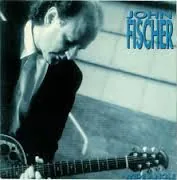
John Fischer
Wide Angle
Reviewed by Arsenio Orteza
Wide Angle is John Fischer's "coming out" album, not from the closet of homosexuality or anything like that, but from the narrower stratum of evangelicalism that he's inhabited for most of his adulthood. One could say, if one is inclined to believe that such a coming out is a good thing, that Fischer's new open-mindedness comes a little late for someone who's been mining the Scriptures for as long as he has.
His recording career goes all the way back to the days of "Jesus Music," and he began writing his pastoral column in CCM at least a decade ago. One could also say, if one is inclined to believe that such a coming out represents not so much an advance into the light as a retreat into the darkness, that Fischer's new open-mindedness is just the latest concession on the part of evangelicals to cultural pressures to slacken standards in general.
Or one could simply say, "It's really brave of you, John, to admit you may have been wrong on some theological points over the years. It takes a lot of guts in a stone-throwing industry like yours to make such an admission and then back it up with an entire CD of songs chronicling your Odyssey."
I'd like to say all three.
First, under the heading, "Why has this renewal of your mind taken so long, John?": I wish that one of these 12 songs dealt with why we humans are so stubborn instead of the mere fact that we are. "I used to think that I was right/A lonely candle in the night," sings Fischer in "Not the Only One." "And while the heart of the world was breaking/I could not feel the aching."
He goes on to blame this cold-heartedness on "all the knowledge (he) had gained" that put him "on a higher plane." In other words, knowledge puffeth up. But why must it do so? Must it do so? If it must, then why learn? As can be expected from a singer-songwriter who uses his songs as homilies, Fischer answers implied questions in such a way that he ends up implying new ones. But before he can realize or address them, his four minutes are up and it's time to fade the song out.
Second, under "Why has this renewal nudged you to the Left and not the Right?": I wish these songs focused Fischer's faith as much as they broaden it. Among his new values are such freewheeling ideas as that you don't have to call yourself a follower of Christ to be one ("The Only Way"), that guilt is bad because it means you don't "have Jesus" ("It All Comes Down to This"), that "truth will always win" so why bother fighting for it (the title track), and that only when you've suffered and sinned a lot can you be of much help to sufferers and sinners ("Cup of Cold Water"). Abortion foes, meanwhile, may be tempted by Fischer's silence on that subject to name him an honorary Indigo Boy.
But I should point out that each of the examples I just cited are balanced in most cases by lines I didn't quote and, roles to play, and, at his best, Fischer weaves them into his big picture with care and theological dexterity. I should also point out that C.S. Lewis, Mr. Adopted Evangelical himself, would have agreed with most or all of Fischer's controversial assertions.
Of course, you can't have controversy without an audience, so my last question is whether or not the straightforward folk-rock that Fischer and his producer, Mark Heard, have fashioned for this album will score pleasure points with enough listeners to have made the effort worthwhile. On the title song and "Beyond the Shadow of a Doubt," Fischer's measured pace and Noel Paul Stookey approximation fit the scheme. I'm not sure, however, that fans of "Sultans of Swing" will forgive "Down to the Water." And I know I wish "O Rocker" were about Ted Nugent or somebody instead of a chair.
3/5