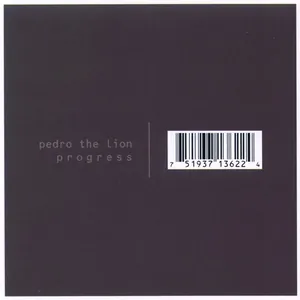
With this year's heated presidential election in gear, Pedro the Lion's second LP, Winners Never Quit, could not possibly have been released at a more relevant time. Just three months after Winners appeared, seemingly almost as an afterthought, Bazan put forth another offering: a four song EP, aptly titled Progress.
While Winners' thematic focus centers on a hypocritical political candidate, the consequences of his ends-justifies-the-means philosophy, and his family, Progress focuses on multiple problems of modern society. The first two songs on the EP, "June 18, 1976" and "April 6th, 2039," originally appeared on a 7-inch included with the children's book A Guitar for Jaine (TNI Books 2000).
The electric guitar guided "June 18, 1976" tells the story of a young, unmarried girl who after delivering her baby and visiting it in the nursery, ascends the stairs of the hospital and jumps off the roof to her gruesome death on the pavement below.
The second song, "April 6th, 2039," is a cacotopian song in some ways reminiscent of Zager and Evans' "In the Year 2525." Here Bazan does something he has not previously attempted on Pedro records -- he uses a drum machine, and melds it to a single acoustic guitar, permeating the song with the desired synthetic and futuristic effect. The content of this song is in many ways comparable to Flannery O'Connor's tales of morality, sans the ugliness and abrasiveness with which they were imbued. This song tells the story of a family to which modern inventions prove to be a hindrance. The family home is filled with such modern features as dining sets guaranteed to be dust free and beds that are self-making. The family is comprised of a nagging wife, an unfaithful, alcoholic husband who's on his second liver, and bragging, lazy children, who are untruthfully assured by their father of their moral goodness. The message that Bazan conveys is that "progress has a way of feigning ease" and that although we're led to believe that modernity's technological advances can cure our moral failings, they are incapable of changing our human nature.
The next two tracks are live radio sessions of previously released songs, both in which the instrumentation is stripped down. "Of Up and Coming Monarchs," with its guitar part resembling the waves of the sea, has Bazan sadly reflecting that there is no longer any safe place to which to flee the draft, as Canada is no longer a viable option, thanks to America's eminence. The closing song, the finely crafted "Letter from a Concerned Follower," is a metaphoric letter to God lamenting the demise of truth, and the emerging nightmares brought about by science, and is in direct conflict with the optimism brought about by modernity's so-called "progress."
The album comes to a close with Bazan's soft, tired voice asking God, "I hear that you don't change / How do You expect to keep up with the trends / You won't survive the information age / Unless you plan to change the truth to accommodate the brilliance of men / Yeah, the brilliance of men."
The album art also coincides with the theme of pseudo-progress -- an error in the html coding resulting in all of the nonsensical technical characters to appear, affirming the EP's idea that progress is not all it's cracked up to be.
Other coverage for this album
Opus 2000Reviewed by Jason MoreheadNo one writes a morality play like David Bazan. Pedro the Lion's first release, Whole, told of one man's struggle with drug addiction before finally finding God's grace, all in 6 songs. It's Hard to Find a Friend had "Big Trucks," one of the catchiest dissertations on the Golden Rule. The Only Reason I Feel Secure had "Letter From A Concerned Follower," which looked at the battle between…Similar sounding releases
 2002onelinedrawingVisitor
 2005Puerto MuertoSongs of Muerto County
 2000Joseph ArthurCome to Where I'm From
 2004Iain ArcherFlood the Tanks
 2004Original Mark EdwardsRewind Tomorrow
 1997Damien JuradoWaters Ave. S.
More from Pedro the Lion
 2004Achilles Heel
 1997Whole EP
 2002Control
 2000Winners Never Quit
 1999The Only Reason I Feel Secure
 1998It's Hard to Find a Friend