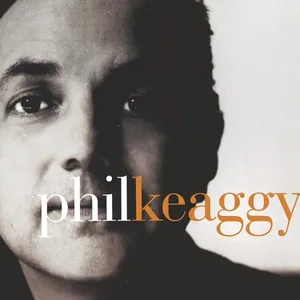
After thirty years of making music, Phil Keaggy still both defines and transcends CCM. His work is certainly contemporary, distinctively Christian to a fault, and just plain great music. If the community of CCM listeners gave out such titles, Phil Keaggy would be the great guitar guru of our particular niche. Unquestionably. Irrefutably. Even arguably the rest of the world as well. Yet his artistic gifts far surpass his unequaled fret-board facility. He is also a skilled songwriter and composer with a definitive sound all his own. If there were ever doubts, his new self-titled album further refutes them. More like squashes them.
Phil Keaggy functions both as a look back and a look forward, yet always with respect to past accomplishments. On Sunday's Child, he paid a fond tribute to a Sixties sound. With this new album, Phil Keaggy pays tribute to himself. Some fans favor the full-on jazz-infused rock edge of such albums as Crimson and Blue, while others prefer the gentler, quieter acoustic-oriented offerings of Way Back Home. This self-titled album offers bits of both without fancying either extreme in a collection that smartly summarizes Keaggy's diverse career. The overall sound, reminiscent of Keaggy's greatest moments, is also notably traditional in its orchestration and instrument choices. For example, there are real drums and keyboards, not the drum tracks and/or poppy synthesized bits that marked albums like True Believers, Getting Closer, and Underground Volume One. Keaggy also avoids some of his past indulgences, like personal songs such as "Olivia" or "The 50th," in favor of more universal fare with wider appeal. Furthermore, the sentimentality that some listeners have branded as quaint has been substituted here for songs that are appropriately emotive without being sappy. Regardless, Keaggy has always championed both God and family in praiseworthy, heartfelt fashion. Fans have come to expect it, and here he neither disappoints nor draws disapproval.
Best of all, Keaggy has never sounded better vocally. Whether he is merely singing more in his range or benefitting from voice lessons is unclear, but the results are appreciable. Keaggy has always had an amply pleasant voice, yet here he sounds less strained, more relaxed and in complete command of both his range and tone. Admirers of his guitar talent, however, are treated only to fleeting demonstrations of Keaggy's singular skill. The guitar work is, of course, considerable throughout. Splashy solos are kept to a minimum, however, in a conscious decision to be less flashy in favor of serving the songs. Consequently, for those wishers pining for another Blue, this album could be less fulfilling initially until overall appreciation of the album's merits is cultivated by repeated listens.
One stand-out cut, "A Sign Came Through a Window," rocks with the kind of enthusiastic energy that Keaggy hasn't produced since Crimson and Blue--it is this album's "John the Revelator." Although it bellows "hit," its presence as the opening track is somewhat deceiving. The rest of the songs don't equal this jamming intensity, although a few like "My Unspoken Words" and "Chase the Bad Away" come close. The second cut, "Beneath the Blood-Stained Lintel," inspired by H.A. Ironside's book The Continual Burnt Offering, creates an appropriately old-English folk sound complete with Irish Pipes by Hunter Lee. "Above All Things," adopting some of St. John Chrysostom's writing on weddings, also offers musical nods to days gone by. Keaggy experimented with Celtic sounds on True Believers and 220, and these songs are two current examples where he does the same to an even greater degree of success.
Notwithstanding the amount of lyrical collaboration he has done on this album, every song sounds like vintage Keaggy. The lush pop track, "Tender Love," is another of his notable homages to The Beatles--one of the best ones he has performed to date and an easy highlight. Geri Bobeck, Keaggy's sister, co-wrote this one as well as "My Unspoken Words," and both songs focus on God's loving kindness and illumination. Keith Moore helped with "A Little Bit of Light" which is a poetic pop song about a struggling soul. The references to Van Gogh and Faulkner, as well as plenty of picturesque imagery, contribute to a catchy song that also recalls James Taylor's finer works. "Under the Grace" and "Days Like You" are just plain pure Keaggy and offer glimpses of God's unending mercy. The album closes with "Jesus Loves the Church," with lyrics that Sheila Walsh wrote for her friend nearly a decade ago. Although not quite as powerful an album-closer as Keaggy's remake of "The Survivor" was on True Believers, "Jesus Loves the Church" accurately captures his heart for encouragement and proclaims the much needed message that, despite our great foibles, our Lord and Groom loves us all completely. It is a hymn worth hearing.
Following over thirty albums in as many years, this is the one Keaggy has chosen to carry his name as the title. Most artists self-title their first albums, or maybe a mid-stream album that marks a change or restructuring of their previous sound. In this case, he uses his name to signify this album represents what he has always been about; Phil Keaggy is as close to a coda to the legendary guitarist's thus far substantial career as you can find. Not only a welcome album for his fans, new and old alike, but one of the best albums of his career. After all, it is good enough to bear his name.
4.5 tocks
Other coverage for this album
The Phantom Tollbooth 1999Reviewed by Elisa MussoPhil Keaggy's latest contribution to the Christian music scene is at least his 24th project as a solo artist depending on how you count these things. The album starts out with a strong acoustic guitar/percussive piece, "A Sign Came Through a Window." It seems to be a call to the listener to take a look at the signs that God has given us to come to faith in Him. "Beneath the Blood-Stained Lintel"…HM Magazine #73Reviewed by Brian Vincent McGovernFrom the first driving acoustic blues rock "Sign Came Through a Window," Keaggy's relaxed, rhythmic songwriting is all over this disc, and his smooth, always Beatle-like voice comes from around the corner, reminding the listener of the man's past work. Often lauded as one of the greatest guitarists who ever lived, such playing is apparent in songs like the acoustic Celtic-flavored Beneath the…The Lighthouse Unsorted 1998Reviewed by Paul Michael CarhartWhenever word gets out that a new Phil Keaggy project is about to hit the shelves, the first thing that comes to mind is: "What's it gonna be this time, Mr. Keaggy?" Ask that question of this project, and one might be surprised. Indeed, Keaggy, who is renowned within both the Christian and mainstream markets for his guitar playing prowess, has traveled many different musical paths from soft…The Phantom Tollbooth 1998Reviewed by James StewartWhen you've been playing music for as many years as Phil Keaggy, you tend to want to experiment and break beyond genres. It's not surprising then that this latest release moves quickly from a Beatlesque opener to Celtic influences and even pulls in a couple of moments of Eastern sounds. Much has been said of Keaggy's vocal similarities to Paul McCartney, and they are fairly obvious on the first…Similar sounding releases
 1995Michael RoeSafe as Milk
 1998Bernard ButlerPeople Move On
 2001DrugstoreSongs for the Jet Set
 2004MarillionMarbles
 2011John JanzenThink Again
 1998Mike Scott / The WaterboysThe Whole of the Moon: The Music of Mike Scott & The Waterboys
More from Phil Keaggy
 2001In the Quiet Hours
 1999Music to Paint By - Still Life
 2001Cinemascape
 1996220
 1990Find Me in These Fields
 1999Music to Paint By - Brushstrokes