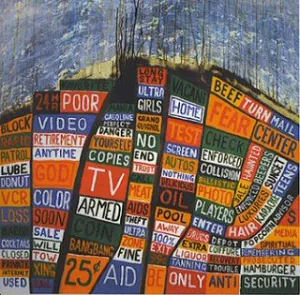
The first time I ever heard Radiohead's new album, Hail to the Thief, was 10 months before it was released, when the band decided to test their new batch of songs for audiences in Spain and Portugal. And when I heard them, I was ecstatic -- I, like many other fans, was convinced that with such beautifully rocking songs as "There There," sinister ballads like "We Suck Young Blood," and the newly refurbished "Lift," Radiohead had a set of songs that could very easily amount to their best album. Comments from the band that they had never sounded better in the studio only added to the excitement. When the album, at the time unfinished, leaked onto the net a few months before release, I refused to download any of the unmastered tracks; I wanted to hear the album in all its completed glory.
And when I did, I was rather shocked and dismayed that it was, in fact, the finished product. What I got was not an amazing album like I had been hoping, but something that seemed rushed, incomplete, and amateur. The album's rockier moments sounded like mere sparks instead of loud bangs, and lead singer Thom Yorke's voice seemed thinned and bored, as if he had grown tired of singing with heart. What happened? Was the band too happy to deliver emotion? Had the once mighty Radiohead become merely average?
It wasn't all bad. Some of my favorites from the live sessions still sounded good, like "There There" and the superb "A Wolf At The Door." But I couldn't help but feel like Radiohead had not put much effort into the recordings, and had produced an album even more middling than the awkward Amnesiac.
But first listens being first listens, it wasn't an impression I'd have for long. A second listen revealed something much, much better than I had first heard, and the third was even stronger. Since then, I've developed mixed feelings, and it's really taken up until now, two months after the album's release, before I've been able to write a review of the album with any confidence. What we have is certainly not the worst they've done, but not the best, either. On their sixth album, Radiohead created, not the masterpiece I was hoping for, nor the nadir I first heard, but rather, an album that is both immensely satisfying and fairly disappointing, one that is high on good songs but low on emotional impact.
The album begins with a bang on the opening duo of "2+2=5" and "Sit Down. Stand Up." On my first listen, the former sounded dull and anti-climactic, while the latter was arguably the worst song they had ever done, with cheesy laser sounds and utterly meaningless lyrics. But now they're two of my favorites on the album. "2+2=5" is downright classic, a James Bond-esque rocker that begins with dank pinging drums and Thom Yorke's haunting vocals, only to unexpectedly explode with a blast of guitar and Yorke's frenzied cries. It's a moment that still gets me with every listen. At only a little over three minutes, it's a short song, which is good -- any longer would have dampened the impact. "Sit Down. Stand Up." is a slowly building mantra, starting out simply with a skittering drumbeat, echoing piano, and vibraphone, but then adding on showers of reverberating guitar and multi-layered vocals, and escalating until it bursts with a racing drumbeat and crashing piano, all while Yorke chants the word "raindrops" in the most robotic of tones, along with the aforementioned laser noises.
Next up is "Sail To The Moon," a piano ballad written about Thom's son, Noah. While I first found the song title and the lyrics to be too clichéd, it has established itself as one of the stronger songs on the album, and certainly one of the more necessary ones on a CD noticeably lacking in ballads. Here, Mr. Yorke sings about leaving a decaying Earth to finding a better home on the moon with the help of a savior figure (and we can assume he's hoping for Noah to be the one doing the saving). It's quite pretty, and the reverb-drenched wails of sound and melancholic piano keep it from sounding too sugary.
From here, though, the album hits a weak point. "Backdrifts" is strong enough, but its swelling blue notes and cheery melody go on for too long at 5 1/2 minutes, and when Thom Yorke cries, "ah ah ah," it's actually rather embarrassing. "Where I End And You Begin" finds the band trying to rock out, and while the drums and bass are some of the best they've ever done, the song just doesn't do much for me. The strong "Go To Sleep" is the better rock song, so full of energy and guitars that it sounds similar to The Bends' "Bones" (although I much prefer "Go To Sleep"). "We Suck Young Blood" is the exact opposite, a tongue-in-cheek piano dirge that, other than a short jazz break, is so sleepy and lethargic, it borders on boring. Which isn't to say it's bad, necessarily; actually, I would say it's one of the stronger songs they've done, but on an album with so many songs, it just seems to increase the length much more than it should, and I usually find myself wanting to hit the "Skip" button.
We're rescued, though, with "The Gloaming," a ghostly electronica song with Thom moaning worried lyrics about alarms and darkness. The band really hits its stride, though, with "There There." One of the highlights of their live performances, it thankfully has lost little of its luster when recorded in the studio. A thumping tribal beat carries the song along, which slowly builds its way to a rocking second half full of clanging guitars and a head-bopping melody. For the first couple weeks of listens, this song made me grin every time I heard it.
After "I Will," a tiny and tired song about rebellion, the CD kind of drops off again. The piano-driven "A Punchup At A Wedding," at first one of the album's catchiest songs, grows old after many listens, and "Myxomatosis" gets lost in all of its fuzzy bass. It's by no means a bad song -- in fact, I love it -- but I can't help but feel that it could have been done so much better; what could have been a ravenous rocker of tremendous force instead is a rather tame rant buried by its ugly keyboards and thick, buzzing bass.
The last two songs are probably the two best. "Scatterbrain" is absolutely lovely, a mellow and elegiac tune that features some of the album's best lyrics and vocals. But it's "A Wolf At The Door" that really steals the show, bombarding the listener with a flood of anxious lyrics and doomy guitars. Lyrically, it's the album's standout, a summation of everything Thom sings about: feeling crushed by an impending future, a job that drains you of your life, and women. And if there's a song out there more fun to sing along to, I'd like to know about it.
As I've probably made clear in my long description, there are some killer songs on the album. But for all the album's great tunes, very few of them are actually emotionally moving. The CD is lacking in what made OK Computer and Kid A such classics: songs like "Exit Music [For A Film]," "How To Disappear Completely," and "Motion Picture Soundtrack," gorgeous and cinematic songs that have made the band legendary. As enjoyable as most of Hail to the Thief is, I long for a sound that is much prettier, and a singer that has more heart.
And that's really what seems to make their sixth LP a disappointment when compared with earlier outings. There's nothing here that really stirs the soul. Instead of concentrating on making a smaller, more cerebral album, they put out an overlong CD of songs that were full of color and life but lacked cohesion and depth. Yeah, they can rock out, but what happened to the band that could make us cry?
But that's not to say the new album is heartless. It's just that this time around, the heart is beating healthily and unbroken. And the songs are shorter and rockier, and it doesn't transcend any boundaries, but that's beside the point (or maybe, that is the point). What the band has created is an album of 14 very different pop songs, and damn good ones at that. It doesn't move you because it's not meant to. The band isn't singing unhappy songs because they're happier people, and their new album makes me pretty cheery sometimes as well.
I don't know about anyone else, but I just find the album to be brimming with so much fun and cute little quirks, from the lyrics of "2+2=5"'s "Eezeepeezeeeezeepeeezee" and "(ah diddums.)" in the CD booklet, to "Peep. 'Yes?' "Mmmmorrre coookiesss..." in the liner notes. It shows that the band isn't entirely a group of miserable pretentious arty people, and it's fun things like these, as well as the sheer quality of most of the songs, that makes me confident in claiming it's one of the best albums of the year. While it regresses musically, songs like "A Wolf At The Door" shows that the band certainly have plenty more ideas up their sleeves, and while it may be average by Radiohead's standards, few albums this year have rocked as hard, inspired as much, or made me smile as much as Hail to the Thief.
Other coverage for this album
Decapolis July 2003Reviewed by Tyler BaberLet's be honest with ourselves, Radiohead owns us. This band is, without a doubt, the new Pink Floyd. The new Led Zeppelin. The new Saturday Night Fever soundtrack. Radiohead is the band of our generation (this generation being everyone buying music since 1995) that has and will stretch and change the bounds of the music industry and popular music itself. Thom Yorke will in the future be looked…The Rebel Base 2003Reviewed by Josh HurstIf nothing else, Radiohead's sixth album, Hail to the Thief, is a smart slap in the face to any detractors who thought the band had dug themselves into a creative hole with their last two records. Kid A and the subsequent Amnesiac were so avant-garde, so cutting edge, and so forward-thinking that some critics feared that Radiohead had no choice but to repeat themselves; leave it to Thom Yorke and…The Rebel Base 2003Reviewed by David MartinIf you're a Radiohead fan, then I probably don't need to tell you this, but I will anyway - someone closely associated with the band appears to have leaked working versions of the songs from their newest album to the Internet a full two months before its release. Having been tipped off as to where I could download these songs, I decided that I would share the proverbial wealth and let those of…The Phantom Tollbooth 2003Reviewed by Tim OdemFor the greatest band of their generation, Radiohead is in a rut. Their string of brilliant but difficult releases throughout the 1990's awarded them critical acclaim and a fervent fan base; both groups ready to unleash rivers of praise at every move the band makes and with good reason. Each album had been a progression in their sound and in their message. From their great pop debut Pablo Honey…The Phantom Tollbooth 2003Reviewed by Steve StockmanPart of me admires Radiohead though my fandom disappeared with Kid A. No longer would I listen for pleasure but for analysis and though some of that analysis is enjoyable and sometimes fascinating, there is a faint suspicion that is hard to admit in public that maybe they are just full of it. I imagine there are those who struggle to admit that they no longer enjoy the band and others who…The Phantom Tollbooth 2003Reviewed by Trae CadenheadIt's difficult, almost impossible, to sum up the significance of the influence that Radiohead has had on the music world as a whole over the past decade. Between the albums The Bends, OK Computer, and Kid A, Radiohead has developed a dedicated following few bands have enjoyed in recent history. Known for its musical innovation, every release from the band has pushed the envelope musically,…Similar sounding releases
 2005Lake TroutNot Them You
 2005InnawayInnaway
 2000Joseph ArthurCome to Where I'm From
 2001SparklehorseIt's a Wonderful Life
 2000ThouPut Us in Tune
 2003Death Cab for CutieTransatlanticism
More from Radiohead
 1998Airbag/How Am I Driving?
 2001I Might Be Wrong: Live Recordings
 2000Kid A
 2001Amnesiac
 1997OK Computer
 1994My Iron Lung