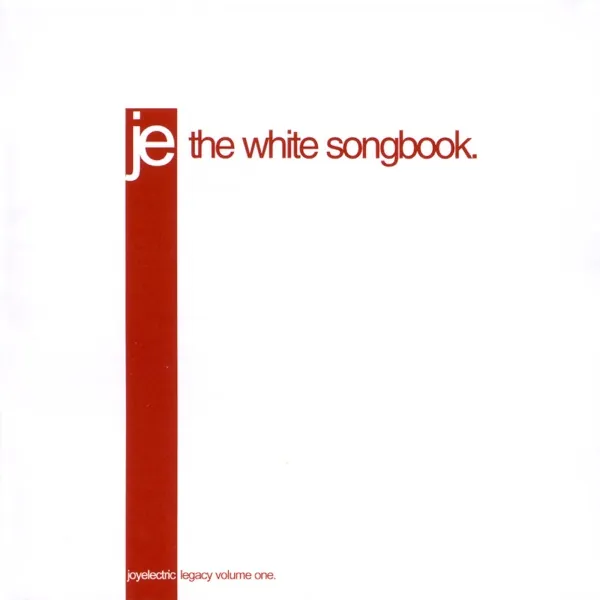
The White Songbook is Joy Electric's attempt at a theme record. Ronnie Martin, the chief composer/songwriter of the group wanted to create a sort of "soundtrack to a great work of Christian Literature," like The Chronicles of Narnia or The Lord of the Rings. This isn't hard to see, as the song titles are divided into chapters and marked by letters instead of numbers, and most of the songs have something to do with fairy tale imagery, which Martin has been relying heavily upon since the band's conception.
This "fairly wonderland" jargon grows tired very quickly, as Martin's metaphors are either too vague to comprehend, or too silly. Take these word from 'The Heritage Bough' for example: "greet me ice queen / in spite / favors once sung by ravers / reared on newsboys learned in Hungarian, by greek historians." What? Though it may make perfect sense to Martin, it sounds like poorly rhymed gibberish to the listener. Whereas Tolkien's and Lewis' use of symbolism and theme are purposeful and clear, Martin seems to be throwing images around that only he has a grip on.
Many of these songs are pretty good by themselves. 'The Boy Who Never Forgot,' 'Unicornicopia,' and the aggressive dance-beat driven 'A New Pirate Traditional,' are solid songs with cool melodies and keyboard hooks. Unfortunately, the album is just too long, clocking in at over an hour, for any of these songs to be really memorable. It's very difficult for a band to hold a listener's attention for this long. The White Songbook is no exception.
Martin uses only electronic instruments on this record. No guitars or drums can be found. Though this is a novel idea, it gets old after three songs. Despite interesting compositions and decent melodies, an hour is much too long to have to listen to the Nintendo-like "bleeps" and "binks" that permeate every song on this record. Much of the record has a sort of eighties/electronic music/Goth feel (see: 'Sing Once For Me'), and though this is fun for awhile, there isn't enough variety to keep the listener interested. There aren't enough surprises, and as many of the songs are over four minutes long, the record spurs impatience and thumb twiddling.
Great theme records have been made in recent years. The Flaming Lip's record, The Soft Bulletin, is full of great lyrical insight and songs that possess a sort of continuity while differing enough to keep the listener interested. This is where Joy Electric falls short. They do not appear to have the musical or lyrical know-how to create such a collection of songs. They have tried to create an epic theme record, and as a result have taken themselves too seriously. Melody, their first record, is great because it doesn't try too hard. It's playful and fun. They seem to have gotten away from this on The White Songbook. It's hard to take a barrage of electronic whistles and beats seriously, especially while Martin is singing about a 'Unicornicopia.' With this record Joy Electric jumped in waters a little over their fairy tale-filled heads.
Other coverage for this album
Opus 2005Reviewed by Frederick K. GhansahReviewing Joy Electric's release presents a quandary. How much can I say without dulling the impact of the work, while still accomplishing the purpose of the review? This is a fine line that must be walked. The best way to sum up The White Songbook is as a "consummation." Things hinted at and approached in earlier works reach their peak here. The complexity hinted at in unreleased tracks such as…The Phantom Tollbooth September 2001Reviewed by Michial FarmerI initially praised Joy Electric's last new-material album, CHRISTIANsongs, but as the months and eventually years went by, I came to regret it. The synthesized punk songs began to feel more and more shallow, and with a few exceptions ("Disco For a Ride"), I didn't want to hear them anymore. I found myself longing for the richly dark songs from albums like Five Stars For Failure and We Are the…Similar sounding releases
 2000Chicks on SpeedChicks on Speed Will Save Us All!
 2002PanicPanic
 2001Gentlemen of LeisureGentlemen of Leisure
 1999The Silent Music ClubThe Sirens of Silence EP
 2004TravelogueImaginary Hospitals
 1999Goodnight StarGoodnight Star
More from Joy Electric
 2004Friend of Mannequin
 2000Unelectric
 1999Children of the Lord
 1995Five Stars For Failure
 2005The Ministry of Archers
 1999Christiansongs